Creative practice
Coffee Ad Steam: Make It Look Warm, Not Like Smoke
Make coffee-ad steam feel warm without hiding the product. Diagnose contrast, origin and density, then build a four-panel composition with a complete prompt.
Believable steam in a coffee ad needs a visible source, room to rise and enough contrast to be seen. Start it at the drink, let it become less distinct as it rises, and keep it from hiding the cup or brand. If the steam looks like a dense white rope, increasing detail will usually make the problem more obvious.
First decide what the ad sells. A coffee-bean campaign may use a prepared drink to suggest a morning ritual. A ceramic-cup campaign needs the handle, rim and surface to remain easy to inspect. The same cloud of steam can help the first image and obscure the most useful information in the second.
Diagnose the steam before changing the whole scene
| Symptom | Likely visual problem | Useful revision |
|---|---|---|
| Steam is almost invisible | Background and plume have similar brightness | Change the local background or light direction |
| Cup seems to be on fire | Dense, opaque plume dominates the frame | Reduce density and separate a few lighter wisps |
| Steam floats above the rim | No visible relationship with the drink | Bring its origin back to the liquid surface |
| Logo disappears behind haze | Plume crosses the part viewers need to read | Redirect the plume into empty background space |
| Every panel repeats the same curl | Effect looks pasted into unrelated scenes | Give each view its own small variation |
Still-life photographer Dina Belenko's coffee-steam tutorial uses light behind the scene to reveal steam and a separate light for the surrounding objects. It also leaves space above the cup. That is a useful way to separate the effect from the rest of the composition; her particular camera settings are not a universal recipe.
Fix contrast without turning the whole ad dark
Place the steam against a quieter area of the background. A dark cupboard behind the upper half of a cup may be enough; you do not necessarily need a black room. A bright window frame running directly through the plume can break it into unreadable fragments.
If you are photographing a reference, arrange the camera, cup and background before pouring the hot drink. Observe how the steam reads as you change the light position. Photograph a short sequence and compare the shapes. Protect the equipment from spills and keep the setup stable; dramatic effects are not a reason to put hot liquid near an unsecured light.
If you are editing an existing photograph, preserve the exposure that already makes the product look good. Ask for contrast behind the steam, rather than darkening the cup, packaging and tabletop together. The product-lighting guide is useful when the underlying material also needs attention.
Build a coffee campaign around one clear moment
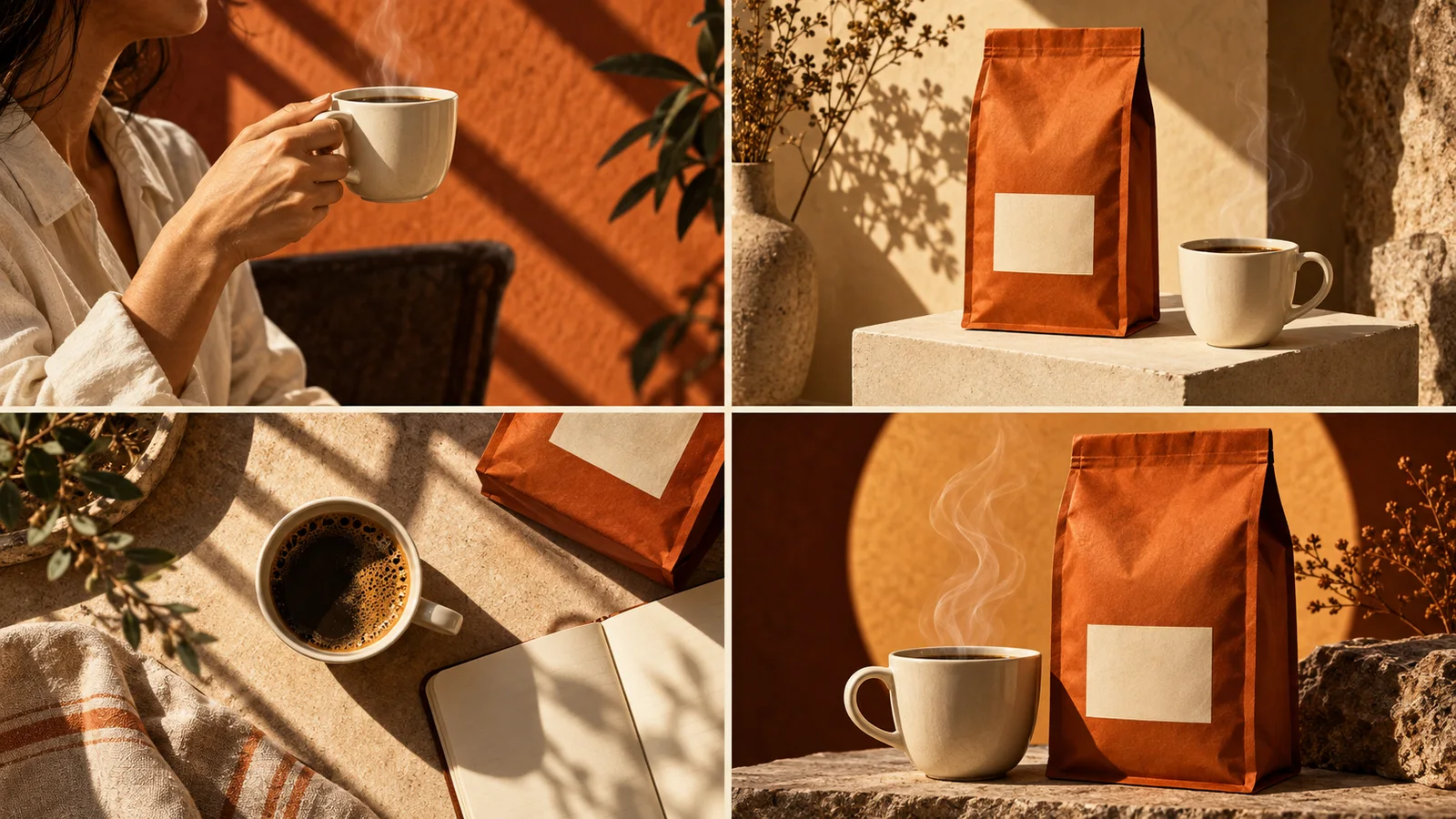
Here is a fictional four-panel concept for a bag of roasted beans and a plain ceramic cup. It illustrates a composition, not a tested advertisement.
| Panel | Image | Role of steam |
|---|---|---|
| Morning cue | Cup beside a closed notebook | A small visible wisp introduces the warm drink |
| Product | The actual bean bag, label facing camera | No steam from the sealed bag |
| Use | Prepared coffee beside the open bag | Steam belongs to the drink and stays clear of the label |
| Closing image | Bag and cup with a short headline | A restrained plume leaves the headline readable |
The contrast between panels matters. If every frame contains the biggest possible cloud, the viewer has four effects to look at and little product information. You can also omit steam entirely from a frame that needs a clean view of the cup's glaze.
A brief for the complete image could read:
Create a four-panel coffee advertisement using @image1 as the exact bean bag and @image2 as the ceramic cup. Keep both products recognizable. Use warm side light and a quiet darker background behind the drink. Show a few fine, irregular wisps rising naturally from the coffee, fading as they rise. Keep steam away from the bag label and cup handle; none should emerge from the sealed bag. Follow this sequence: morning cup, clear bag close-up, prepared coffee with the bag, then a composed closing frame. Include the headline “Make room for a slow morning” and the closing text “Explore the coffee” in the finished image.Bring your actual references into Panelly Studio. The headline and closing text can be part of the generated image; a separate text-layer workflow is not required for this concept.
Compare the product first, then the atmosphere
Check the handle, rim, fill level and packaging before judging the effect. If those have changed, keep the previous version and request a narrower correction. A beautiful plume cannot compensate for the wrong product.
Then reduce the image to its intended display size. The steam should support the warm-drink cue without becoming a gray veil. If the ad only works when enlarged, simplify the plume and remove competing background lines.
Can steam also work in a short video?
Yes, but inspect where it starts and how it changes through the shot. A frozen curl or a plume that jumps at the cut can reveal the effect. Request gentle variation while preserving the cup, rather than adding several camera moves to disguise it. Our video continuity guide explains how to locate the first faulty frame.
Does more steam make coffee look better?
Not reliably. The useful amount is the amount that communicates a warm drink while keeping the product clear. Compare a restrained version with the current one; do not assume the denser effect is the stronger advertisement.